
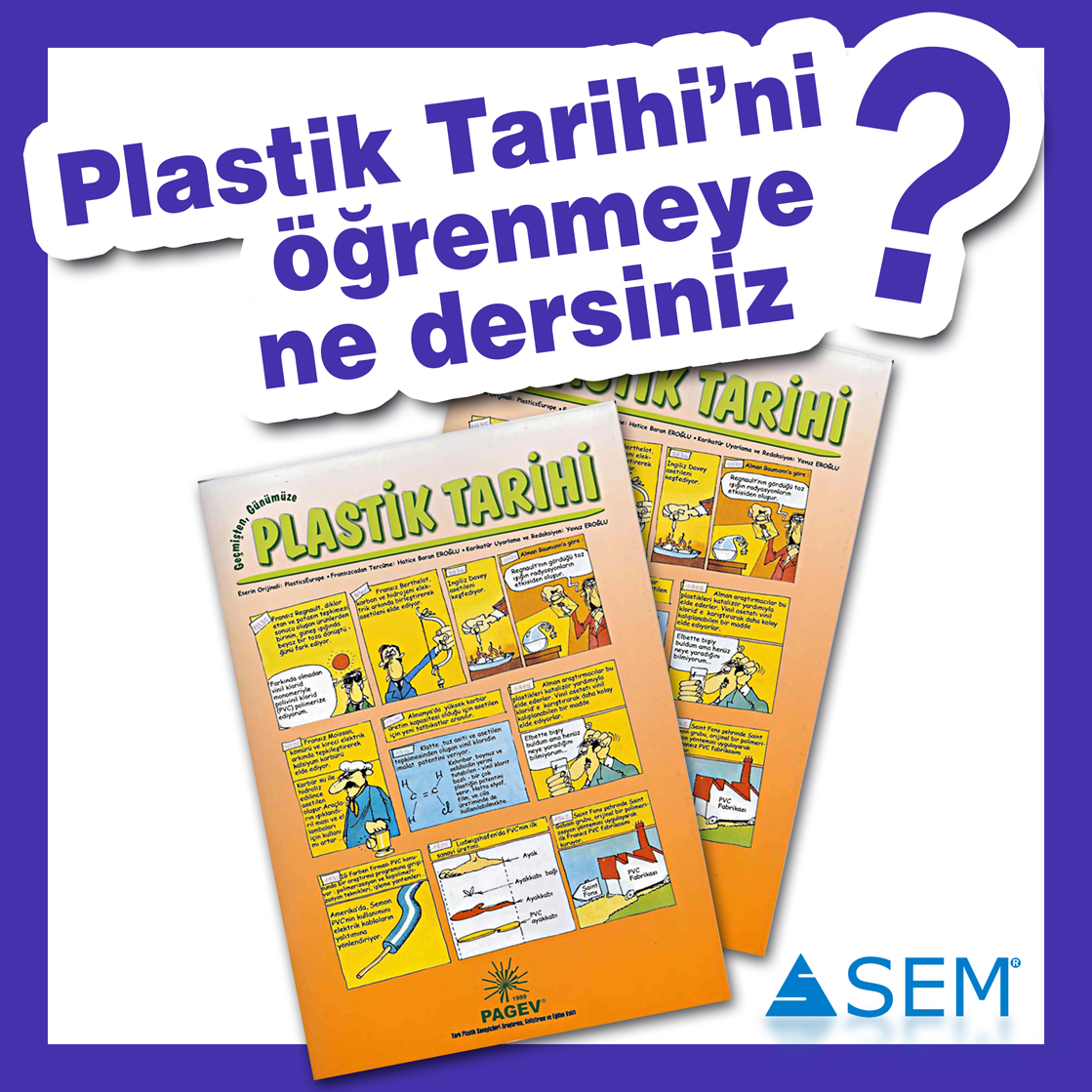
History of Plastic from Past to Present
To access the book, please click on this link or on the book cover image. Original Work: PlasticEurope Translated from French: Hatice BARAN Cartoon Adaptation and Editing: Yavuz EROĞLU PAGEV Publications, 2nd Edition, December 2014, Istanbul The Child Sitting on the Chair… Year:…

To access the book, please click on this link or on the book cover image.
Original Work: PlasticEurope
Translated from French: Hatice BARAN
Cartoon Adaptation and Editing: Yavuz EROĞLU
PAGEV Publications, 2nd Edition, December 2014, Istanbul
The Child Sitting on the Chair…
Year: 1979. Industrial markets made up of small workshops reached through dark corridors, their walls appearing as if painted with machine oil, staircases worn down from constantly moving machines… Local injection machines, either imported second-hand or produced by craftsmen trying to overcome their inexperience, exhausted workers with sooty hands and faces, strong dark tea with bitter carbonates served in branded cups, payphones, brightly colored oralet drinks, black-market raw materials, the roar of machines, workers speaking in a variety of accents after recently migrating to the big city, arabesque music blaring from cassette players until the electricity went out, and most striking of all: everything—buildings, machines, masters, apprentices, workers, tea, telephones, sacks of raw materials, and cassette players with muffled, lidless speakers—covered in a black layer of machine oil.
For the child sitting on the chair, while the machines, the workers, and the act of working were fascinating, the environment was equally cold, dirty, and gloomy.
.JPG)
Here it is… the very place where plastics began in Turkey. Bayrampaşa, Istanbul. The children sitting on those chairs, the fathers who brought them to the workshops at every opportunity, and the plastic industry itself—all of them crawled their way from these beginnings to reach today’s achievements.
Today, plastic is everywhere: in the incubators where we place our babies, the plates we eat from, the cups we drink from, our clothing, shoes, window frames, doors, carpets, pipes, insulation, toothbrushes, televisions, computers, refrigerators, balls we play with, seat belts, cars, airplanes—not just in health, but also in medicine… in our lenses, surgical threads, hearing aids, many body prosthetics, heart valves, and countless other places you can imagine. Plastic is an inseparable part of our lives. The material of our century.
And in Turkey, plastic became the name of success. This sector, growing from those small workshops, has, with determination, ambition, and passion, brought Turkey to the position of the third largest plastic processor in Europe as this book went to print.
The child on the chair grew up and had a long-standing love affair with this material—experiencing its fragrance, witnessing its elegance as it transformed, feeling its warmth—and continues to do so…
Many years ago, at a fair in France, he immediately bought a comic book on the history of plastics and brought it to Turkey. He had it translated into Turkish and worked to adapt the comic to Turkish. He tried, as much as possible, to recreate the jokes with Turkish equivalents or, if not possible, with locally familiar expressions. This work is the result.
The children on the chairs, the fathers, the masters, apprentices, and workers—all of them, coming from those difficult conditions to the present day—wanted to share the warm and elegant side of plastics with all the curious minds, especially with the children who will write the success stories of the future.
First, I would like to thank ALMAK Ateş Makina and ALTECH Plastik Makina for supporting this project from the very beginning and making it possible for this work to reach you. Without the dedicated efforts of Hatice Baran—the mother of Ali Kaan and Ömer Erhan, who translated the original work from French into Turkish while simultaneously improving its Turkish adaptation—we would not have been able to present it to you. I owe them my sincere thanks.
Yavuz EROĞLU
Chairman of the Board, PAGEV