

At the New Plastics Economy Conference organized by the Sustainability Academy, “Green Practices in Plastics for Sustainability” were discussed
Source:pagev.net At the New Plastics Economy Conference, “Green Practices in Plastics for Sustainability” were discussed Representatives from the private sector, public institutions, academia, and civil society who attended Turkey’s first International New Plastics Economy…
Source:pagev.net
At the New Plastics Economy Conference, “Green Practices in Plastics for Sustainability” were discussed
Representatives from the private sector, public institutions, academia, and civil society who attended Turkey’s first International New Plastics Economy Conference, organized for the first time by the Sustainability Academy, called on the business world to “establish a circular economy without delay.”
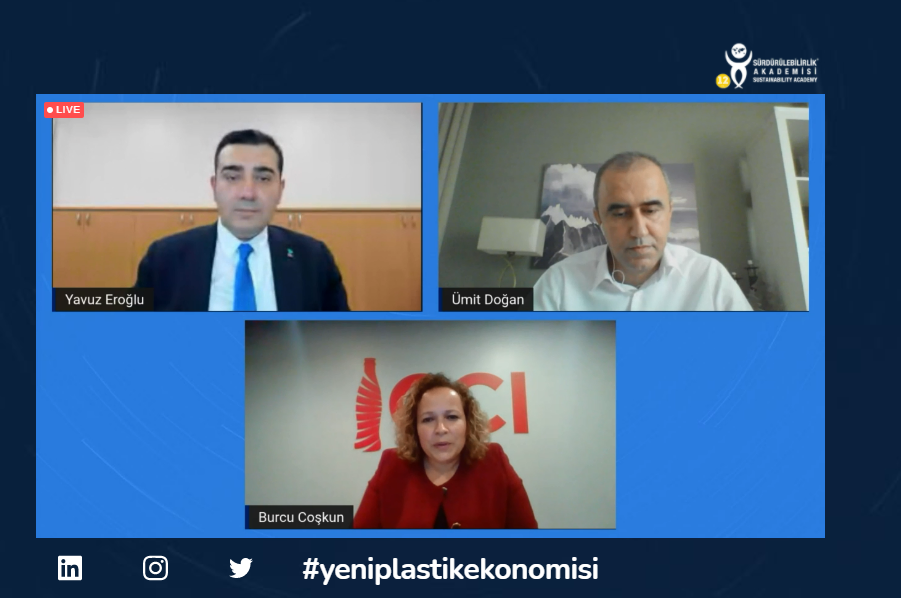
Held for the first time in Turkey, the international conference took an in-depth look at the concept of the circular economy, focusing not on whether “a world without plastic pollution is possible,” but rather on “what can be done together to make it a reality.” The New Plastics Economy Conference, held online on February 10, 2021, featured a session titled “Green Practices in Plastics for Sustainability.” The session was moderated by Yavuz Eroğlu, Chairman of the Boards of PAGEV, PAGÇEV, and SEM Plastik, and included speakers Burcu Coşkun, Group Corporate Affairs Manager at Coca-Cola İçecek, and Ümit Doğan, Procurement Manager at McDonald’s.
Yavuz Eroğlu, Chairman of PAGEV, PAGÇEV, and SEM Plastik, stated that the permanent marks left by humankind on the planet have become unsustainable, leading to a growing environmental awareness around the world. Eroğlu noted that there are currently four major megatrends shaping the global landscape: “These are 5G in communications, health technologies, payment systems, and, most importantly, green technologies. Green technologies will play the most crucial role in shaping the future of our world. When we look deeper into green technologies, we see systems built on renewable energy sources to combat climate change, effective waste management, and strong recycling systems. In this context, it is of great importance that plastics—which have increasingly become a part of our lives over the past century—are managed through efficient waste management systems. To achieve sustainability, we must first ensure conscious consumption. It is important to base our approach on the principle of ‘not consuming unless necessary,’” he said.
Emphasizing the importance of conscious consumption, Eroğlu noted that excessive and unnecessary consumption—just like with any other material—causes massive waste worldwide in the case of plastics. He highlighted that, as a widely used material, plastic is one of the most important topics in green technologies, and made the following remarks:
“To achieve sustainability, we must first ensure conscious consumption. We need to understand that the world’s resources are not limited to the money in our pockets. It is important to base our approach on the principle of ‘not consuming unless necessary.’ Another key issue is to ensure that, once we have finished using products, they are disposed of properly and not left in nature. It is also our country’s responsibility to develop this system through a solid waste management infrastructure. In recent years, policies such as zero waste and the increased emphasis on recycling have been particularly critical—these are essential steps to ensure sustainability. This trend continues worldwide as well. Plastic has no place in nature, but it plays a major role in our lives.”
Burcu Coşkun, Group Corporate Affairs Manager at Coca-Cola İçecek, said:
“During the pandemic, we needed plastic and plastic packaging more than ever. However, we also had the opportunity to see very closely what can happen when plastic is not managed properly. Therefore, it is impossible to ignore this need, but also impossible to ignore the fact that we have not been managing it correctly.”
Coşkun added:
“Today, many speakers from the public sector, civil society, and private sector have loudly stated that the transition from a linear economy to a circular economy is now being embraced. Many projects related to this have already been implemented within the industry. We believe that brands like ours should take a pioneering role in this regard. We should set an example for all segments of society with best-practice implementations that go beyond legal requirements. In this sense, we believe that every package has a life and a value beyond its first use. Therefore, all our strategies are shaped around this circular approach.”
Ümit Doğan, Procurement Manager at McDonald’s, said:
“In a changing world, work is being done on reusable packaging beyond single-use packaging to meet the demands of more conscious customers. Our focus is on an ecosystem that encompasses all of McDonald’s initiatives related to sustainability, including sustainable food production, reducing the carbon footprint, and supporting young employees. To add value to packaging and the industry, we have concentrated on four main areas: reducing packaging consumption, using alternatives instead of certain materials, managing the lifecycle of single-use products, and optimizing source materials. Plastic, which is present everywhere today, is a material that needs to exist. Therefore, it is not possible to say that plastic should not exist at all. What matters is whether plastic is used efficiently, correctly, in an environmentally friendly way, and in a manner that adds value.”