

Turkish packaging firm creates opportunities in West Bank
When Turkish plastics executive Yavuz Eroglu opened a packaging factory in 2008 in Hebron, in the West Bank, politics was the last thing he was thinking about. Instead, what Eroglu saw was an underserved market and an investment opportunity for his Istanbul-based thermoforming and extrusion business.

Eight years later the joint venture, Elite For Plastic, employs 50 in Hebron, about 20 miles south of Jerusalem.
It’s gotten Eroglu and his Turkish company, Sem Plastik San. ve Tic. A.S., unusual attention in international development circles for being an early investor in the West Bank’s industry.
But it’s not been easy. It’s required a steady hand to manage both normal problems and unique challenges, such as occasional flare-ups of the Israeli-Palestinian conflict.
Violence, while not common everywhere, does happen, he said: “Sometimes you can see clashes just five blocks away. You can hear it, but you are into the business.”
It has also had problems importing plastic from Saudi Arabia, he said, because any material getting into the West Bank has to go through Israeli customs controls. So it switched to a resin supplier in Israel.
The JV focuses on solving problems and pushing ahead, Eroglu said. And there have been benefits in Hebron, like access to a good labor force, he said.
Eroglu said he’s taking a long-range view, even if it’s not a huge commercial success.
“I don’t get any profit now but I am expanding this business,” he said. “I send machines whenever I had old machines. I still believe in this project.
 |
Backing into the West BankEroglu didn’t initially seek out business in the West Bank. As he tells it, he basically backed in. In 2006, he was trying to get rid of excess thermoforming machines left over from modernizing his Istanbul operations. With $58 million in annual sales, Sem is one of the larger thermoformed packaging companies in Turkey, and Eroglu said he didn’t want his used machines to find their way to a new domestic competitor. So he looked for buyers or partners on business trips to nearby countries, including Romania, Bulgaria, Algeria and Israel. It was during a trip to Israel to visit customers that he got a call from SEM Plastik’s Palestinian distributor, Hatim Hasouneh, who wanted to meet in Hebron. Eroglu, who said he first asked if it would be safe to travel there, made the short trip. Despite not initially thinking it was a place for his surplus machines, he wound up spending two days in Hebron, as the idea of manufacturing locally took hold. “Two days I was there, I checked out the market,” he said. “In Hebron, this place was an old industrial zone, it’s like old Beirut. |
“I asked if there are skilled people,” he said. “I found out most of the people have finished university degrees but there is no business over there. So you could find workers.”
Eroglu said he could see imported Chinese packaging increasing in the West Bank, and thought an investment in partnership with Hasouneh would strengthen their position.
After some negotiation, and talking through concerns about whether political conditions could interfere with day-to-day business like importing spare parts, he said the partners decided to move ahead with the 50/50 joint venture.
Palestinian staff went to Sem’s factory in Istanbul to train on the machines and learn maintenance, and in 2008 they started operations.
The partners didn’t want public attention — even though Eroglu says he was one the first foreign investors in industrial production in the West Bank — but just to start, quietly.
“Nobody knew it and I didn’t want anyone to know it because I don’t want to be in a political dilemma,” he said.
The quiet strategy worked, he said, for a year or two, until Eroglu’s investment was made public — not by his choice — at a forum on Turkish-Palestinian business links. But in the end, Eroglu said the disclosure has worked out fine.
He’s told the story of Elite For Plastic at international conferences on Palestinian business investment, like a 2012 event in Washington organized by the Aspen Institute.
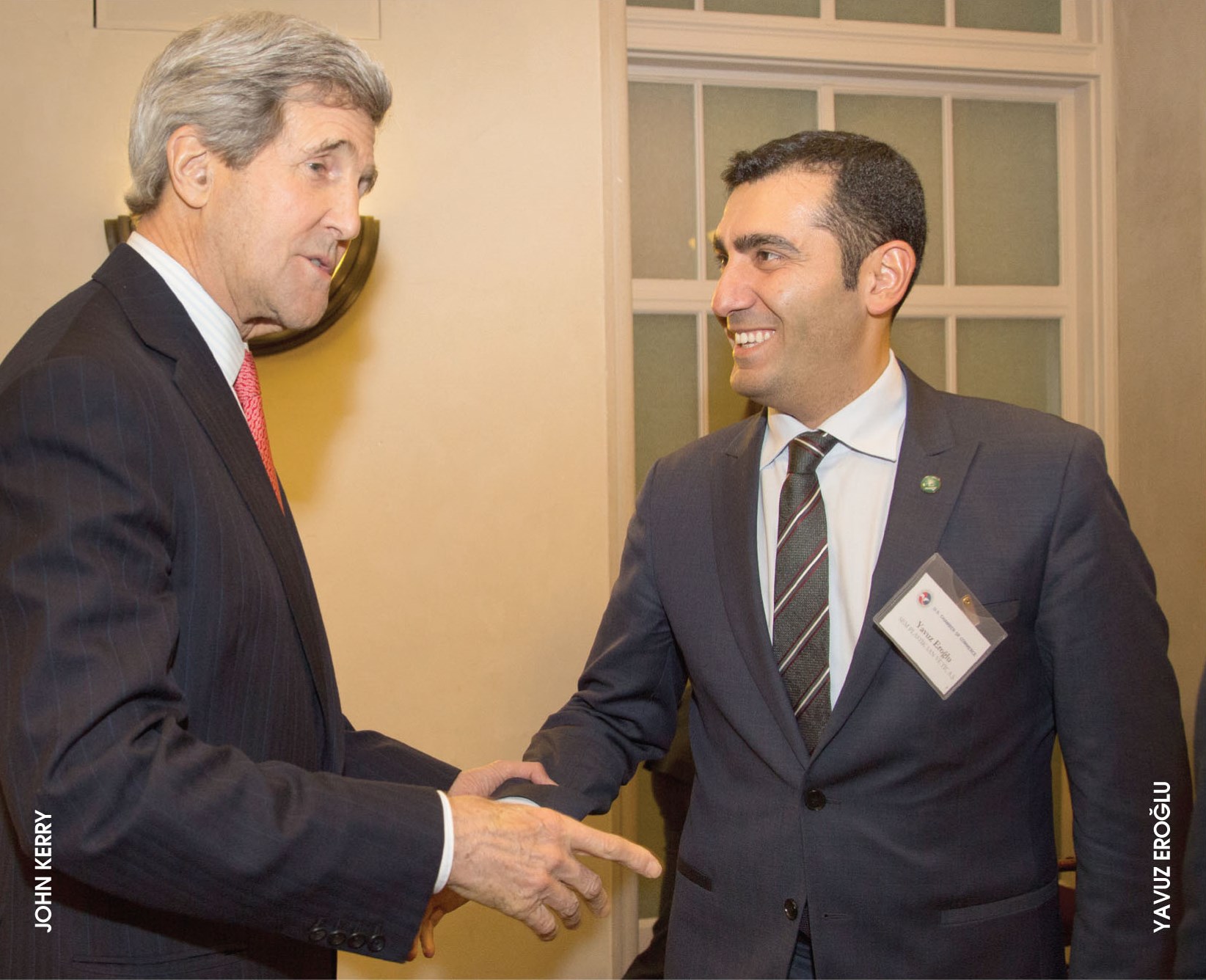
He’s personally met U.S. Secretary of State John Kerry as part of his work on an advisory board of the Middle East Commercial Center, which is part of the U.S. Chamber of Commerce.
Eroglu, who is also president of the Turkish plastics trade association Pagev, is one of 15 members of the MECC advisory board, which includes a former Israeli ambassador to the United Nations, an ex-president of the Arab League and former U.S. Trade Representative Charlene Barshefsky.
As well, Eroglu said he’s been asked by joint business delegations from the European Union and the Palestinian Authority about how to spur more investment.
He said his advice was simple: determine what Israel imports, as a high-consuming market, and figure which of those could be made in the West Bank.
Small factories like Elite For Plastic, which is one of larger plastic packaging firms in the West Bank, could be a better start than trying to bring in major investment, he said.
In fact, Eroglu said, his joint venture has become an informal business incubator in the West Bank, as some former employees leave Elite For Plastic and start their own operations.
“The last time I was there. … I was surprised that we had nine or 10 competitors producing the same product of cups,” he said. “And there are nine or 10 competitors producing paper cups. And it all started because of this moment.”
The extra competition is not good for Elite’s bottom line, Eroglu admits. But he takes pride in the development, which he estimates helps 30 local suppliers to Elite and provides jobs.
“It is bad for business, I am sorry there is competition, OK, but I also feel some pride because we did something,” he said. “This is good. People will feel they can do production here, it’s learning. It’s good.”
Eroglu said he’s taking a long-term view of potential there.
“I still believe that this business which I am growing [in Palestine] will be an important business,” he said. “It’s small now, it’s not compared to what we have in Turkey at the moment, but it’s unique. It’s something special.”