
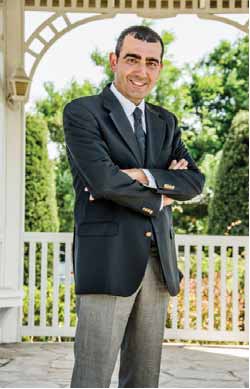
Aslı Söylebil's interview with Yavuz Eroğlu, General Manager of capital magazine, was published in the Green Business supplement.
Cooperation for Clean Sea
Yavuz Eroglu and his interest in the environment in WFO'da talked about his work.
.jpg) SEM plastic Chairman Yavuz Eroğlu, Turkey, Middle East and Africa presidency of the Waste Free Oceans movement, which was launched in Europe. In this context, it continues its cleaning activities on the coast of Turkey and the region. Eroglu, in Turkey, other sectors other than plastic is indifferent to this issue. He pointed out that we can not prevent environmental pollution by sweeping the front of our door and said, “more than half of the waste on the coast of Turkey is not from Turkey. Water is the only way to prevent it because it carries waste,” he said.
SEM plastic Chairman Yavuz Eroğlu, Turkey, Middle East and Africa presidency of the Waste Free Oceans movement, which was launched in Europe. In this context, it continues its cleaning activities on the coast of Turkey and the region. Eroglu, in Turkey, other sectors other than plastic is indifferent to this issue. He pointed out that we can not prevent environmental pollution by sweeping the front of our door and said, “more than half of the waste on the coast of Turkey is not from Turkey. Water is the only way to prevent it because it carries waste,” he said.
Turkey, Middle East and Africa, SEM plastic Board Chairman Yavuz Eroğlu of the Waste Free Oceans movement started in Europe. As a result of her family business, she started to deal with the environmental effects of plastics because of her family business. Eroglu believes in the concept of responsible industry, not dry noise. “I do my job, put the money in my pocket and I'm out of time. Now people are sensitive about it. If you really want your work to be sustainable, you can't do anything against society.”
Eroglu draws attention to the pollution caused by solid waste dumping into the sea especially on the shores of Iskenderun and Marmara, says that we can not get rid of just sweeping the front of our door. “More than half of Turkey's seabed waste is not sourced from Turkey,” Eroglu said, adding that the only way to prevent this is worldwide cooperation. We talked with Yavuz Eroğlu about his interest in the environment and his work in the WFO.:
When did your environmental awareness start?
In 1994, we had a small packaging workshop inside the industry when we were a student in ITU. When you're a plastic surgeon, environmental issues are becoming even more interesting. In those days, since ITU was engineering-intensive, there was no Mobin club at the school, but there was no environmental club. One day I'm like that in your canteen
when I was talking to a curious friend of mine, I said, “Let's set up something like this with the students here. Let's explore the environmental issues on our behalf, find out what the facts are, and engage in activities related to them.” Before we couldn't convince anyone to join the club. So, if we were to make a surprise opening, we did a little trick there with the idea of attractive income to people. As members of the two-person club, we wrote a letter inviting the Environment Minister Riza Akçalı to open. It was such an article that he probably thinks there's a thousand people in this club. At that time, the habitat summit will begin. We think we can do something with habitat after the opening. As a matter of fact, we fooled the minister. It was a very sensational opening with the participation of the minister. Even the rector was surprised to see if he was looking to open a club. After that, we did a lot of activities, including habitat. This is how my interest in the environment began, and I've been trying to keep it up all my life.
Are you relieved about the damage to the environment of plastics?
Plastic is the best alternative to the environment, I would say. About 40 percent of the total oil in the world goes to vehicle vehicles. We burn 40 percent at home, 4 percent goes to plastic production. Plastic recycling is the easiest material. Other materials, such as glass, are recycled at very high temperatures, under very difficult conditions. The shampoo we wash our hair in the morning, the slippers we wear on our feet, the lens in our eyes, the clothes we wear are plastic in everything. The reason why these products are made of plastic is that plastic is cheap. There is not enough wool or cotton to wear a population that has grown so much in the world. So plastic, not because it produces plastic, but because it is used in need. But if there is no recycling system in a country, then we have a problem. Today, many products, such as bumper cars, Black hangers in hotels, are made of recycled plastic. Therefore, you can be used by recycling the product you obtained from 4 percent of the oil at first.
Why did you feel the need to focus on coastal cleaning?
I am a member of the Executive Board of the European Union of plastic manufacturers (EUPC) within the European Union. Two years ago, the European Parliament MP, Anna Rosbach, head of the environmental and Public Health Commission, established a foundation called Waste Free Oceans (WFO) for the removal of marine waste on the EU coasts. Rosbach said to Eupc “let's clean up together” in accordance with the industrial concept responsible for most of the waste because it is plastic. Eupc has a partner. So when I saw this project, I thought about what I could do. I also realized that we are not aware of sea waste because nuclear energy and land waste are always spoken in Turkey. In Europe today, this is the first environmental issue.
How did you start working with WFO?
I said to them, “you're doing this thing wrong.” Because their foundation was based on clearing Europe's seas by 2020. I said, “clean up all you want, we will pollute Turkey,” they were surprised. Because sea waste is moving, it has to turn into a movement along the Mediterranean coast. There's no point in clearing the European coasts alone. They really went to their minds and decided to globalize the movement. I am Vice President of the Turkish Plastics Industry Research, Development and Education Foundation (pagev). We said that we should support this application in Turkey within the concept of responsible endüstü as pagev. After this initiative, Anna Rosbach said, “We have decided among ourselves, and we have made you the president of the Middle East, Africa and Turkey, and you are responsible for that region.”
what kind of work have you done on the coasts where you are responsible for WFO until now?
The most important work in our region was carried out at Sayda port of Lebanon. In 1982, in Lebanon, during the Civil War, the country was devastated. One of the first mind he's dumping the rubble on the shores of the sea. Because the country is mixed, they throw garbage there. After that, it's the city's garbage. Every time the wave comes, he takes some garbage and moves it to the other shores. It's the most polluted region in the entire Mediterranean for years. There was a project that was part of the WFO about the cleanliness of the place. The European Investment Bank (EIB) financed the collection of garbage and rehabilitated it elsewhere. Cleaning up the coastal waste that existed in the WFO was going to work. The money EIB gave to the Lebanese state was somehow lost from the bank.
It's one of the biggest scandals out there. WFO continued to do coastal cleaning, and we cleaned the bottom with divers. Three or four weeks ago, Jeremy Irons made a film about Sayda port called “Thrash”. We also have an activity in Egypt. With our project partner over there, we're getting inventory of the Egyptian landfill.
What are the most critical areas of marine pollution in Turkey?
Unfortunately in Turkey, we are not in the desired place at solid waste storage point. Even in Marmara, many municipalities still discharge the Marmara Sea. So the biggest problem is land waste. Like that in this world already. Eighty percent of marine waste is land-based. There is a problem with the storage areas of municipalities mainly in Turkey. Solid waste depot in certain places near the sea. There is such a risk in Iskenderun's blind-Fez. There is a problem in the solid waste storage areas of municipalities in Marmara and in the Mediterranean. There's no point in them being on shore.
What kind of waste have you encountered during the cleaning on our shores?
The highest figure in cigarette butts. Other than that, there are plastic bottles. We have two works on that. There is a study by the Turkish Naval Research vak-fo (TÜDAV) in Fethiye. An international organization, called Ocean saving, takes inventory of wastes on the coast of turkey every year. There's even medical waste in the inventory.
Do you have work to convert collected waste?
The system works as follows: There is still the possibility to disassemble the available ones with what we call mechanical conversion and convert them back to the product. However, you have been in the sea for a long time and the economic value of the recycling is no longer in parts of Izay-dash burning plants and convert them to energy. When the plastic burns, it gives better energy than coal.
What sectors do they need to lead?
If you look at the concept of responsible industry, the cigarette industry should be involved if there is a substantial butmarit between the waste. Then there are metal boxes, like a box of coke, and they don't. Glass products are not surface waste, but they fall to the bottom of the sea, so they have to be. There is now a sustainable business model in the world. I'm doing my job, put the money in my pocket and I'm out of here.
THE WAR IN SURIYE CONTAMINATES HATAY COAST”
According to a survey by tüdav, more than half of the waste on the Sea coast in Turkey is not from Turkey. The only way to prevent this is to create a worldwide movement. It's very close to our shores, so there's waste coming from there. Events in Syria, municipal solid waste system çalıştıramayacağığı Lazkiye landfill waste, Hatay's Samandağ district comes. This is such a creaking issue that a study on the Black Sea coast found the waste of an island country in the Pacific Ocean. Because waste is traveling with water. It's not lost when you throw away the garbage, it's definitely coming out somewhere in the world. Everyone will clear their own capsule, of course, but also a group of work needs to be done. When you say that I have cleaned Turkey all alone, it does not mean much. Greece is a very problematic country in this respect.